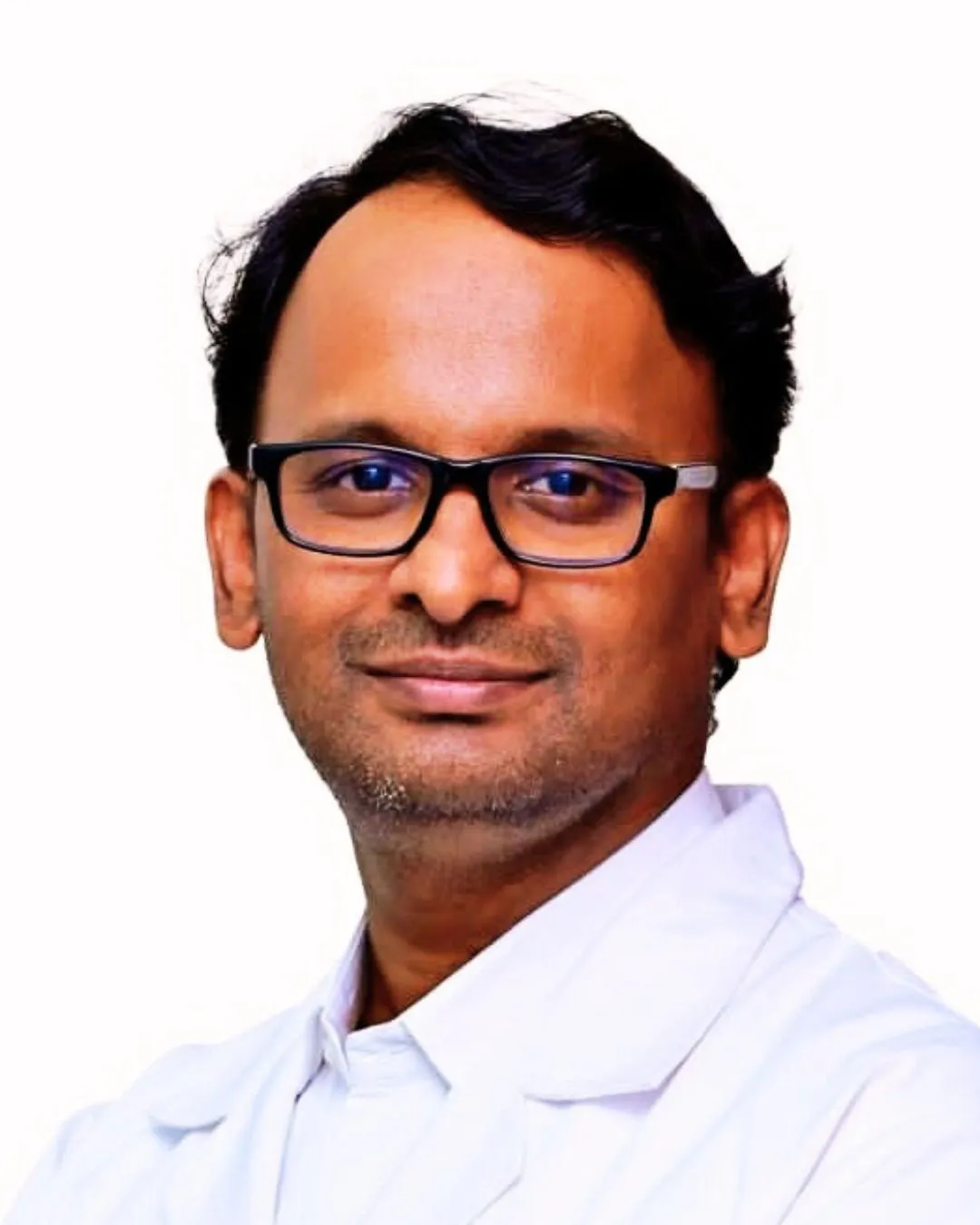
Minimally invasive keyhole surgery for complex liver, gallbladder, pancreatic, bowel, and hernia conditions — smaller incisions, faster recovery, same precision. Performed by Dr. Srinivas Bojanapu (MBBS, MS, FACRSI, DrNB, PDF) at Kauvery Hospital, Electronic City and Dhaara Liver Clinic, Yelahanka.
Laparoscopic surgery — also called keyhole surgery or minimally invasive surgery — is a modern surgical technique where the surgeon makes 3–5 small incisions (each 5–12 mm) in the abdomen instead of one large cut. A tiny camera (laparoscope) is inserted through one incision; the live high-definition image guides the surgeon as specialised instruments work through the remaining ports.
For most abdominal operations today, laparoscopic surgery has replaced open surgery — offering dramatically less post-operative pain, shorter hospital stays, earlier return to work, and cosmetically better outcomes. Complex HPB cases may be augmented with robotic assistance for greater precision.
Laparoscopic hepatectomy for benign cysts, HCC, liver metastases. Left lateral sectionectomy, segmentectomy.
Laparoscopic cholecystectomy — the gold-standard for symptomatic gallstones. Day-surgery in most cases.
Distal pancreatectomy, pancreatic cyst enucleation, and selected Whipple's procedures via laparoscopy.
Laparoscopic right/left hemicolectomy, anterior resection, abdominoperineal resection for colon and rectal cancer.
TEP and TAPP laparoscopic inguinal hernia repair. Laparoscopic ventral hernia repair (IPOM).
Laparoscopic spleen removal for ITP, haematological conditions, and hypersplenism from portal hypertension.
Laparoscopic Nissen fundoplication and Toupet fundoplication for GERD refractory to medication.
Laparoscopic appendix removal for acute and chronic appendicitis. Usually same-day or next-day discharge.
| Factor | Laparoscopic | Open Surgery |
|---|---|---|
| Incision size | 3–5 ports of 5–12 mm each | 15–30 cm single incision |
| Hospital stay | 1–3 days | 5–14 days |
| Return to work | 2–3 weeks | 6–8 weeks |
| Pain level | Significantly lower | Higher (wound pain) |
| Blood loss | Less (typical 50–200 mL) | More (typical 200–500 mL) |
| Infection risk | Lower | Higher |
| Scar | Minimal (3–5 small dots) | Long visible scar |
*Figures are typical ranges and vary by individual case and complexity.
Most patients requiring abdominal surgery are suitable candidates for laparoscopy. Factors that Dr. Bojanapu evaluates when planning your procedure:
In select complex cases — particularly major liver resections or Whipple's procedures — Dr. Bojanapu uses the Da Vinci Xi robotic system at Kauvery Hospital, which provides 3D magnification and wristed instruments for unmatched precision. Learn about robotic surgery →
With over 16 years in surgical gastroenterology and HPB surgery, Dr. Bojanapu has performed hundreds of laparoscopic procedures including complex liver resections, laparoscopic Whipple's, and robotic-assisted HPB surgery at Kauvery Hospital, Electronic City — one of South Bengaluru's premier surgical centres. He holds DrNB (Surgical Gastroenterology) from Sir Ganga Ram Hospital, New Delhi — a nationally recognised centre for advanced minimally invasive surgery.
Laparoscopic surgery (keyhole surgery) uses small 5–12 mm cuts through which a camera and instruments are inserted. The surgeon views the operation on a high-definition screen and performs the procedure without a large incision, allowing faster recovery, less pain, and smaller scars.
Yes. In experienced hands, laparoscopic hepatectomy is as safe as open surgery with significantly faster recovery. Dr. Srinivas Bojanapu has over 16 years of experience performing laparoscopic HPB procedures at Kauvery Hospital, Electronic City, Bengaluru.
Most laparoscopic procedures allow discharge within 1–3 days compared to 7–14 days for open surgery. Return to normal activity is usually within 2–4 weeks depending on the operation. Cholecystectomy is typically a day-procedure.
Both are minimally invasive. Laparoscopic surgery uses straight handheld instruments and a 2D or 3D camera. Robotic surgery (Da Vinci Xi) uses wristed instruments with 7 degrees of freedom, 3D magnification, and motion scaling — providing superior precision for complex HPB and reconstructive procedures. Dr. Bojanapu uses both at Kauvery Hospital.
For acute abdomen, obstruction, or perforation needing urgent surgery:
📞 88846 94233