
Centre for Liver Transplant Surgery, Bangalore
End-stage liver disease demands more than medication — it demands a surgeon who has performed this operation hundreds of times, a team built around the single goal of keeping both donor and recipient safe, and a programme that stays with the patient long after they leave the ICU.
Dr. Srinivas Bojanapu — MS · DrNB · PDF — Hepatologist, Liver Transplant & HPB Surgeon, Bangalore
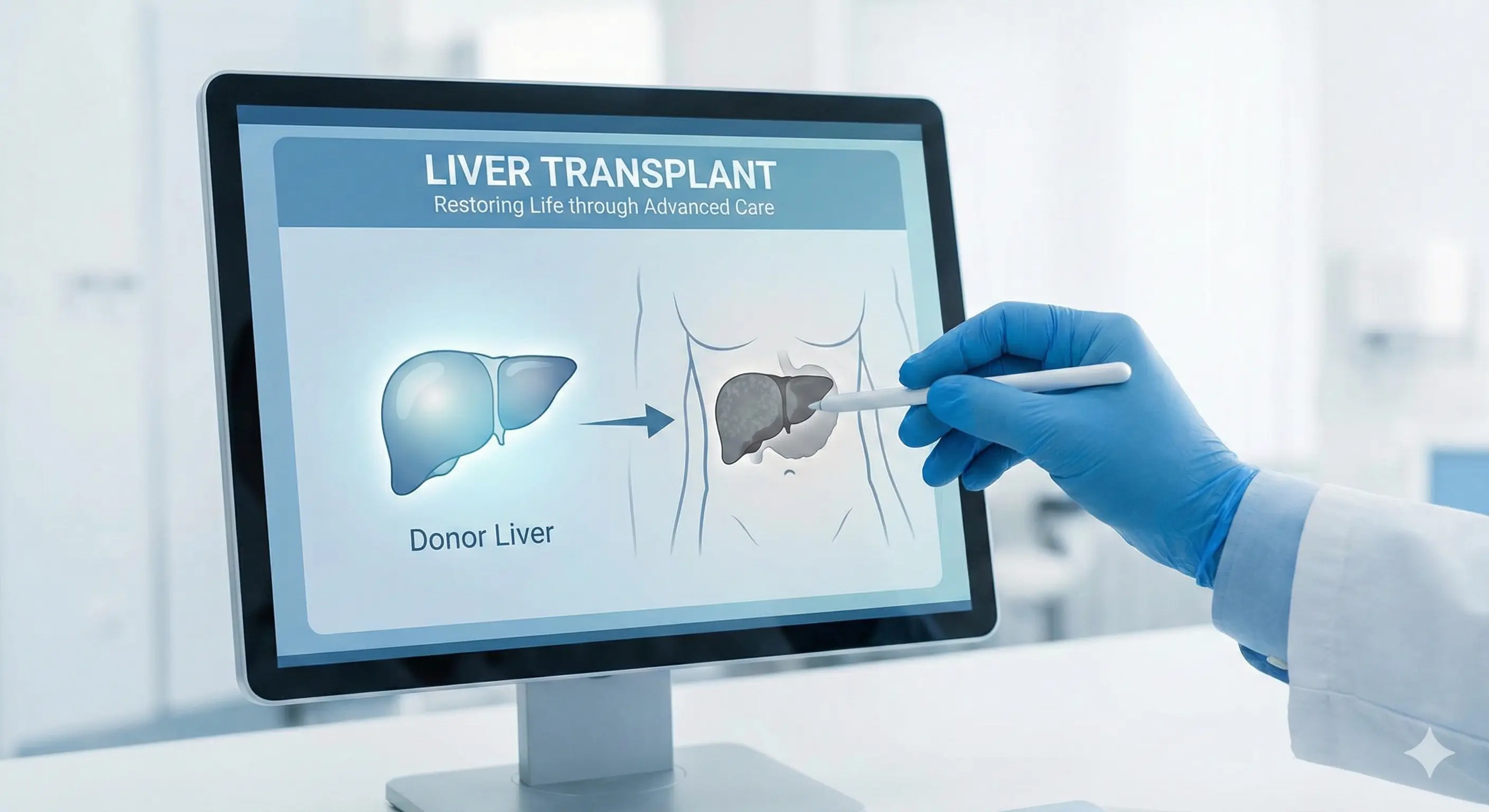
When Is Liver Transplantation the Only Option?
The liver is a resilient organ — it can compensate for significant damage for years before giving way. But when compensation fails and the liver can no longer perform its core functions — filtering toxins, producing clotting factors, metabolising drugs, synthesising proteins, and maintaining fluid balance — liver transplantation becomes the only intervention that can restore normal physiology and save the patient's life.
As a liver transplant surgeon in Bangalore, Dr. Srinivas Bojanapu evaluates every patient for transplant candidacy based on the severity of liver dysfunction (quantified by MELD score), the underlying cause of disease, the presence of complications such as hepatic encephalopathy, refractory ascites or hepatorenal syndrome, and the patient's overall physiological reserve. Transplantation is not recommended lightly — the decision is made only when the benefits of surgery clearly outweigh the risks of a major operation and lifelong immunosuppression.
-
Decompensated Cirrhosis When cirrhosis progresses beyond compensation to jaundice, ascites, variceal bleeding, or hepatic encephalopathy that cannot be controlled with medical or endoscopic therapy.
-
Acute Liver Failure Sudden, life-threatening liver collapse from viral hepatitis, drug toxicity (paracetamol overdose, herbal supplements), or Wilson's disease, requiring emergency listing through the ZCCK or TRANSTAN deceased donor registry.
-
HCC within Milan Criteria A single tumour ≤5 cm, or up to three tumours each ≤3 cm, confined to the liver with no vascular invasion. Transplant offers both oncological cure and removal of the cirrhotic background liver that would generate future tumours.
-
Alcohol-Related Liver Disease Selected patients with severe alcoholic hepatitis unresponsive to steroids, or end-stage alcoholic cirrhosis, following rigorous psychosocial evaluation and documented sobriety commitment.
-
Metabolic Liver Diseases Wilson's disease, end-stage haemochromatosis, MASLD-related F4 cirrhosis with complications, and primary biliary cholangitis or primary sclerosing cholangitis failing all medical therapies.
-
Chronic Hepatitis B & C Cirrhosis Despite highly effective antivirals (TAF for HBV, DAAs for HCV), patients who present late with established decompensated cirrhosis will not recover adequate synthetic function on medications alone and require transplant evaluation.
MELD (Model for End-Stage Liver Disease) is the universal scoring system used to prioritise liver transplant candidates. Calculated from serum creatinine, bilirubin, INR, and sodium, a MELD score above 15 generally indicates that transplant improves survival over medical management. Scores above 25 carry a 3-month mortality exceeding 50% without transplant. All patients with MELD ≥15 should be referred to a liver transplant surgeon in Bangalore for evaluation without delay.
The Dual-Track Programme — Two Pathways to a New Liver
Our transplant programme in Bangalore offers both pathways simultaneously. This is clinically important: many patients are evaluated for LDLT and DDLT in parallel, so that if the preferred living donor is found to be unsuitable at the last stage of workup, the deceased donor listing is already active. LDLT provides speed, organ quality, and surgical control; DDLT provides access for patients without a compatible living donor.
The gold standard for elective transplantation. A healthy, ABO-compatible relative donates the right lobe of their liver — approximately 60% of the total volume. Surgery is planned, timing is controlled, and organ quality is prime. The donor's liver regenerates to near-normal volume within 6–8 weeks.
Explore LDLT ProgrammeFor patients without a suitable living donor. The whole liver is retrieved from a brain-dead donor through the ZCCK (Karnataka) or TRANSTAN (Tamil Nadu) government registry, with allocation governed strictly by MELD score and blood group. Surgery is performed on an emergency basis, often at night.
Explore DDLT ProgrammeTransparent 1-year and 5-year survival statistics for our programme, benchmarked against international registries including UNOS and ELTR. Published outcomes drive accountability and help patients make fully informed decisions.
View Our OutcomesLDLT vs DDLT — A Detailed Comparison
Choosing between a living donor and a deceased donor transplant is one of the most consequential decisions a patient and family will make. The comparison below covers every factor that influences the choice — from organ quality and surgical timing to cost structure and donor risk. This table is reviewed in detail at every transplant consultation at our Bangalore centre.
Scroll right to view full table on mobile.
| Feature | Living Donor (LDLT) | Deceased Donor (DDLT) |
|---|---|---|
| Donor Source | Healthy blood relative or spouse | Brain-dead patient via ZCCK / TRANSTAN |
| Waiting Time | 2–3 weeks (planned) | Months to years (uncertain) |
| Organ Quality | Optimal — healthy donor, full pre-operative evaluation | Variable — depends on donor age, ICU duration, and cause of death |
| Surgery Timing | Elective, daytime, full planned team | Emergency — often midnight or weekend |
| Organ Transplanted | Right lobe (~60% of donor liver volume) | Whole liver |
| Allocation Basis | Family and clinical decision | Government MELD score + blood group priority |
| 1-Year Patient Survival | ~95% (elective cases) | ~90% (very good) |
| Cost Structure | Two operations: donor surgery + recipient surgery | Higher organ retrieval, transport, and extended ICU costs |
| Donor Risk | Small but real — 0.1–0.5% major complication rate in high-volume centres | No donor risk (deceased) |
| Cold Ischaemia Time | Very short — liver transplanted same day, same centre | Longer — retrieval, transport, and back-table preparation add hours |
| Best For | Patients with a healthy, willing, compatible relative | Patients without a suitable living donor candidate |
The Pre-Transplant Evaluation — What to Expect
Before any patient is listed for transplant — whether LDLT or DDLT — they undergo a comprehensive multi-disciplinary workup that typically takes place over five days at our Bangalore centre. This evaluation serves two purposes: to confirm that transplant is the correct treatment, and to identify and optimise any conditions that could increase peri-operative risk. The same evaluation applies independently to the proposed living donor, conducted by a separate surgical team to ensure no conflict of interest influences the assessment.
Day 1 — Baseline Bloods & Cross-Sectional Imaging
Complete liver function panel, viral serology (HBV surface antigen, HCV antibody, HIV, CMV, EBV), full blood count, coagulation screen, renal function, thyroid, and tumour markers (AFP, CA 19-9). Triphasic CT abdomen and pelvis to assess portal vein anatomy, hepatic arterial supply, liver volume, and any space-occupying lesions. Chest X-ray and 12-lead ECG.
Day 2 — Cardiac & Pulmonary Clearance
2D Echocardiography to measure ejection fraction, pulmonary arterial pressure, and valvular function. Dobutamine stress echocardiography if ischaemic heart disease is suspected. Pulmonary function tests (spirometry). Arterial blood gas to screen for hepatopulmonary syndrome. Cardiology sign-off is mandatory before listing.
Day 3 — GI Endoscopy & Specialist Reviews
Upper GI endoscopy to screen for oesophageal and gastric varices, with prophylactic endoscopic variceal ligation (EVL) applied if high-risk varices are found. Nephrology review if creatinine is elevated or hepatorenal syndrome is suspected. Dental clearance to eliminate oral sepsis. Chest CT if any pulmonary nodule or lesion is seen on chest X-ray.
Day 4 — Psychosocial Assessment & Financial Counselling
Psychiatry evaluation — particularly important for patients with alcohol-related liver disease, where a minimum 6-month period of documented sobriety is required. Social worker assessment of family support structure, post-discharge care capacity, and compliance likelihood. Transplant coordinator review of insurance pre-authorisation, government scheme eligibility, and total cost estimation.
Day 5 — Multidisciplinary Transplant Board Decision
Hepatologist, liver transplant surgeon, transplant anaesthetist, intensivist, cardiologist, and transplant coordinator review all findings collectively in a formal MDT meeting. A final listing decision is documented, the MELD score is recorded for registry submission (ZCCK or TRANSTAN), and an estimated surgical date is confirmed for LDLT cases where a donor has cleared evaluation.
Patients with a MELD score above 20 should seek transplant evaluation without delay. Above MELD 25, 90-day mortality without transplant exceeds 30%. Early evaluation does not commit a patient to surgery — it preserves the option if and when it becomes necessary, and critically, allows time to identify and prepare a living donor.
Safety Protocols & Infection Control
Liver transplant recipients are placed on high-dose immunosuppression in the early post-operative period, making them profoundly susceptible to bacterial, fungal, and viral infections during the critical first 90 days. Our transplant programme in Bangalore employs a multi-layered infection prevention strategy, maintained continuously by the nursing, pharmacy, and intensivist teams around the clock.
Life After Liver Transplant — The Long-Term Picture
A successful liver transplant is not the end of treatment — it is the beginning of a new chapter that requires lifelong engagement with the transplant team. The first year is the most demanding: drug doses change weekly, the immune system is being recalibrated, and the graft is still being accepted. Beyond 12 months, the vast majority of patients lead near-normal lives, return to work, travel, and require only quarterly or biannual reviews. Understanding the trajectory allows patients and families to plan realistically.
-
Hospital Discharge Timeline Recipients typically spend 5–7 days in the transplant ICU, followed by 10–15 days in the hepatology ward. Total hospitalisation for uncomplicated LDLT is 15–22 days. Donors are discharged in 5–7 days.
-
Immunosuppression for Life Tacrolimus (FK506) remains the backbone of long-term immunosuppression, typically combined with mycophenolate mofetil in the first year. Doses are reduced progressively as tolerance develops but cannot be discontinued.
-
Follow-Up Schedule Weekly for the first month, fortnightly for months 2–3, monthly through the first year, then quarterly indefinitely. Blood tests at every visit monitor graft function, drug levels, and renal function.
-
Dietary Restrictions High-protein, low-sodium diet for the first 6 months. Raw or undercooked foods are prohibited while on high-dose immunosuppression. Grapefruit and pomelo are permanently contraindicated due to CYP3A4 inhibition which dangerously elevates tacrolimus levels.
-
Permanent Prohibitions Alcohol — zero tolerance, lifelong. Herbal and Ayurvedic supplements — many are hepatotoxic and can precipitate acute graft rejection by competing with immunosuppressant metabolism. NSAIDs — nephrotoxic in combination with tacrolimus and calcineurin inhibitors.
-
Return to Normal Activity Light walking from week 2 post-discharge. Driving from week 6–8. Desk work and light activity from month 2. Physical labour, contact sports, or heavy lifting only after 6 months and with explicit surgical clearance.
Published data from high-volume liver transplant centres internationally show 5-year patient survival rates of 75–80% for LDLT and 70–75% for DDLT. Beyond the first year, the primary causes of late death are cardiovascular disease and de-novo malignancy — both driven by long-term immunosuppression — rather than graft failure. Annual cancer surveillance (colonoscopy, skin examination, PSA in men, mammography in women) is recommended from year 3 post-transplant onwards as part of the standard long-term follow-up protocol.
The Multidisciplinary Transplant Team
Liver transplantation is the most team-dependent operation in surgery. The outcome is determined not just by the surgical technique of the liver transplant surgeon but by the integrated performance of every specialist who touches the patient from the moment of listing to the decade of follow-up that follows. Our transplant team in Bangalore is constituted to cover every dimension of this journey.
Common Questions — Liver Transplant in Bangalore
Ready to Discuss Transplant Options?
A detailed consultation with Dr. Srinivas Bojanapu will cover your current liver status, MELD score, living donor suitability assessment, and a realistic timeline to transplantation.
Book a Transplant Consultation