✓ Bangalore
✓ ZCCK Registered
✓ 16+ Years
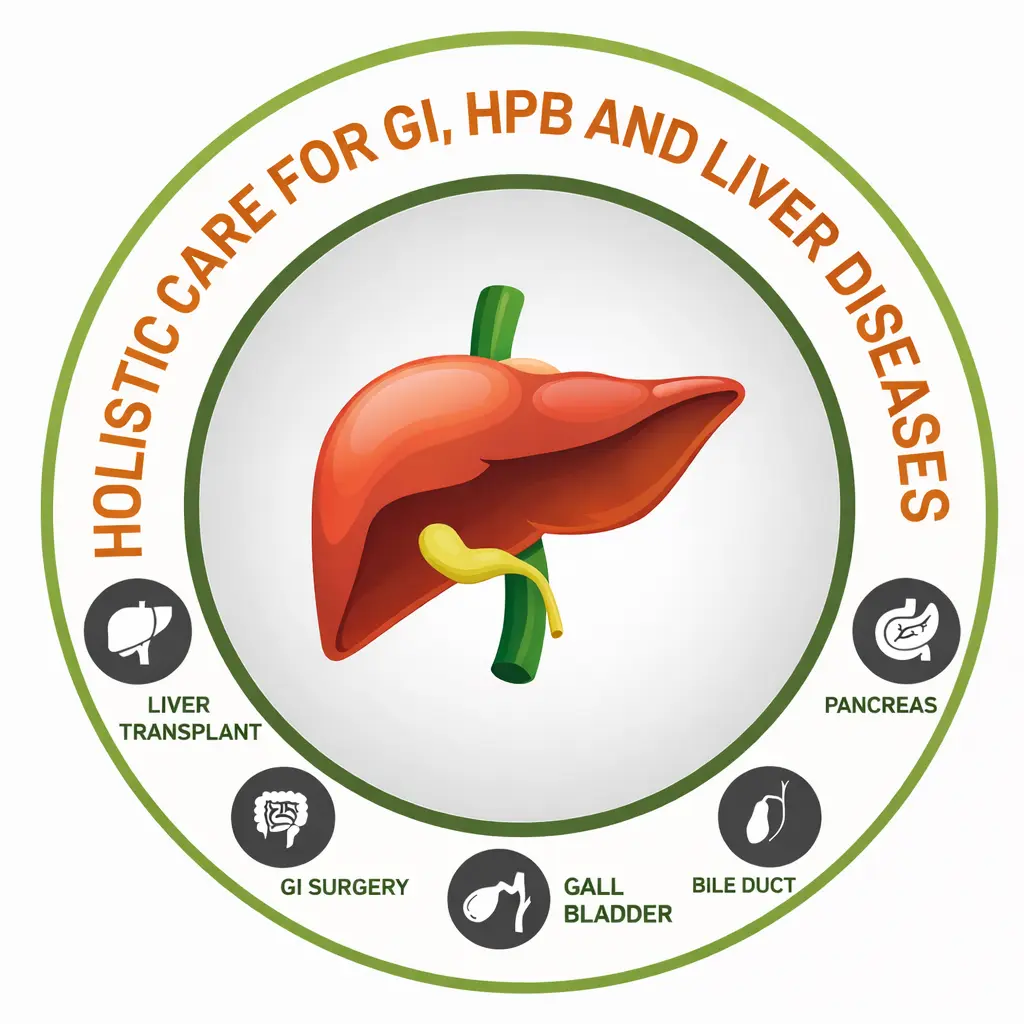
Curative and palliative surgical treatment for cancers of the liver, pancreas, colon, rectum, gallbladder, and bile ducts — by Dr. Srinivas Bojanapu, gastrointestinal cancer specialist in Yelahanka, North Bangalore. Robotic and minimally invasive options available.
Dr. Srinivas provides specialist surgical treatment for the full range of gastrointestinal cancers at Dhaara Liver Clinic, Yelahanka, and Kauvery Hospital, Bangalore.
Hepatic resection, liver transplant (within Milan criteria), ablation (RFA/MWA), TACE. Multidisciplinary approach with oncology and interventional radiology. Available in Yelahanka, North Bangalore.
Learn more →Whipple's procedure, distal pancreatectomy, borderline resectable assessment with neoadjuvant therapy. Robotic Whipple's for suitable cases. Bangalore's experienced pancreatic cancer surgeon.
Learn more →Right/left hemicolectomy, anterior resection, robotic low anterior resection for rectal cancer. TME technique for optimal oncological clearance. Laparoscopic colectomy available in Bangalore.
Extended cholecystectomy with hepatic bed resection and lymphadenectomy. Management of incidental gallbladder cancers after laparoscopic cholecystectomy in Bangalore.
Hilar (Klatskin) and intrahepatic bile duct cancer surgery. Liver resection with biliary reconstruction. Liver transplant for selected hilar cases. Specialist bile duct cancer surgeon in Bangalore.
Subtotal and total gastrectomy with D2 lymphadenectomy. Robotic gastrectomy for eligible cases. Pre-operative staging with PET-CT and laparoscopy. Gastric cancer surgery in Bangalore.
Every complex GI cancer case is reviewed at a multidisciplinary tumour board (MDT) involving surgical oncology, medical oncology, radiation oncology, radiology, and pathology before a treatment plan is finalised.
This ensures that the optimal sequence of surgery, chemotherapy, targeted therapy, and radiation is planned — not surgery first by default, but surgery at the right time with the right preparation. This approach is the global standard at the best cancer centres and is the standard at Dr. Srinivas's practice in Bangalore.
Liver, pancreas, colorectal, gastric, gallbladder, and bile duct cancers — all under one specialist surgeon in Yelahanka, North Bangalore. No need to visit multiple hospitals.
Da Vinci Xi robotic surgery and laparoscopic approaches for eligible cases — faster recovery, less pain, minimal scarring, and superior oncological precision.
Cases declared inoperable or requiring complex re-do surgery are evaluated. Send your reports on WhatsApp for a prompt expert opinion without waiting for an appointment.
Dhaara Liver Clinic, Yelahanka and Kauvery Hospital serve patients from Hebbal, Devanahalli, Jakkur, Bellary Road, and Kempegowda Airport corridor — specialist GI cancer surgery in your neighbourhood.
Dr. Srinivas Bojanapu at Dhaara Liver Clinic, Yelahanka is a senior GI oncology and HPB surgeon with 16+ years of subspecialty experience. He is one of North Bangalore's most experienced cancer surgeons, offering robotic, laparoscopic, and open surgical options for all major GI cancers.
GI oncology surgery is the surgical treatment of cancers of the digestive system — liver, pancreas, colon, rectum, stomach, gallbladder, and bile ducts. Depending on the cancer type and stage, the goal may be curative (complete tumour removal) or palliative (symptom relief). Modern GI cancer surgery increasingly uses robotic and laparoscopic techniques for better recovery.
Yes. Dr. Srinivas performs robotic GI cancer surgery using the Da Vinci Xi system in Bangalore — covering robotic Whipple's, liver resection, colorectal cancer surgery, and gastrectomy. Robotic surgery offers 3D HD magnification, tremor-free precision, and faster patient recovery compared to open surgery.
A multidisciplinary tumour board (MDT) is a formal review of complex cancer cases by surgical, medical, and radiation oncologists along with radiology and pathology specialists. It ensures the best treatment sequence is chosen — not surgery alone, but surgery combined with chemotherapy and radiation at the right time. This is the international standard of care for GI cancers and is practised at Dr. Srinivas's clinic in Bangalore.
Send your biopsy report, CT scan, PET scan, or hospital summary directly to Dr. Srinivas on WhatsApp at +91 87478 74888. You will receive an expert surgical opinion promptly — no need to wait for a formal appointment to get an initial assessment.