✓ Bangalore
✓ ZCCK Registered
✓ ZCCK Registered
Dr. Srinivas Bojanapu is a fellowship-trained HPB (Hepato-Pancreato-Biliary) surgeon in Bangalore with 16+ years of experience in complex liver resections, the Whipple procedure, bile duct surgery, and minimally invasive pancreatic surgery. He practises at Dhaara Liver Clinic, Yelahanka and Kauvery Hospital, Electronic City.
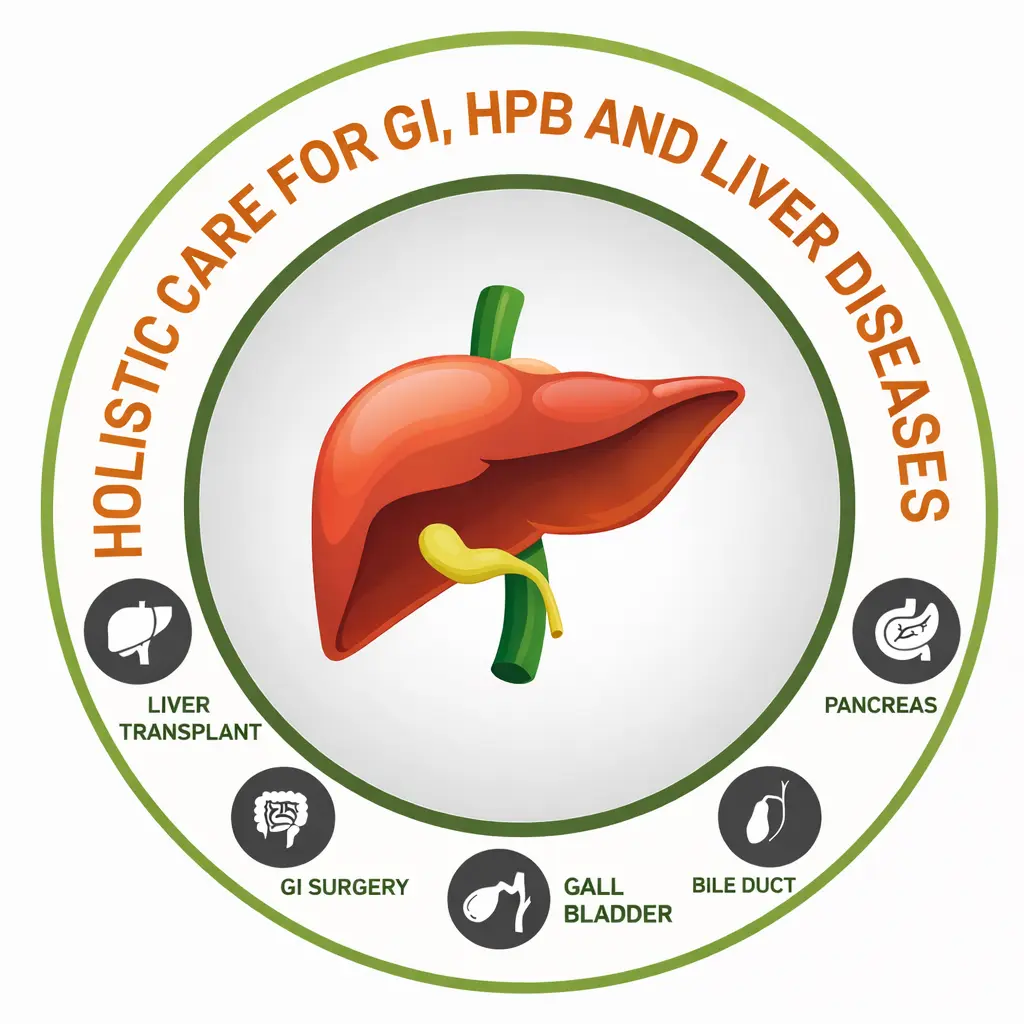
HPB stands for Hepato-Pancreato-Biliary — the liver (hepato-), the pancreas (pancreato-), and the bile ducts and gallbladder (biliary). These three organs work as an integrated system: the liver produces bile, the bile ducts carry it to the intestine, and the pancreas sits at the centre of this anatomy, sharing its ductal drainage with the bile duct through the ampulla of Vater.
When disease affects any part of this system — cancer, stones, strictures, cysts, or inflammatory damage — the surgical treatment often requires operating on two or three of these organs simultaneously. This is why HPB surgery emerged as a distinct subspecialty: the operations are among the most technically demanding in all of surgery, requiring precise anatomical knowledge, advanced laparoscopic skill, and deep experience managing post-operative complications specific to this region.
In Bangalore, most patients with HPB conditions are first seen by gastroenterologists or general surgeons who rightly refer complex cases to a dedicated HPB surgeon. Dr. Srinivas Bojanapu completed his DrNB in Surgical Gastroenterology at Sir Ganga Ram Hospital, New Delhi — one of India's premier HPB training centres — and a Post-Doctoral Fellowship in Liver Transplant and HPB Surgery under RGUHS. He brings this subspecialty expertise to patients in Yelahanka, Hebbal, Jakkur, and across North Bangalore.
Dr. Srinivas manages the full spectrum of hepato-pancreato-biliary disease at Yelahanka and Electronic City, Bangalore
Primary liver cancer. Surgery (resection or transplant) offers the only cure. Laparoscopic resection for selected tumours.
Only 15–20% are operable at diagnosis. Whipple or distal pancreatectomy gives the best survival when resectable.
Bile duct cancer — perihilar (Klatskin) and distal types. Requires bile duct resection with hepatico-jejunostomy reconstruction.
Often found incidentally after cholecystectomy. Re-resection with bile duct excision and regional lymph nodes may be curative.
Intraductal papillary mucinous neoplasm — a pre-cancerous cyst requiring surveillance or resection based on worrisome features.
Congenital cystic dilation of the bile duct. Requires complete excision to prevent cholangiocarcinoma risk. Can be done laparoscopically.
Understanding the operations that treat liver, pancreas, and biliary disease
Removal of the head of the pancreas, duodenum, lower bile duct, and lymph nodes. Three separate bowel connections are then created. Performed for pancreatic head cancers, ampullary cancers, and duodenal tumours.
Removal of part of the liver — from a single segment to a full lobe (hemi-hepatectomy). The liver regenerates to near-normal size within 6–8 weeks. Laparoscopic resection is offered for tumours in accessible segments with significantly faster recovery.
After bile duct excision for cancer or injury repair, the cut end of the bile duct is sewn to a loop of small intestine (Roux-en-Y hepatico-jejunostomy). Precision is critical — a 1–2 mm anastomosis that must remain patent for life. Used for cholangiocarcinoma, choledochal cyst, post-cholecystectomy injury.
Removal of the body and tail of the pancreas, often with the spleen (spleen-preserving is sometimes possible). Performed for tumours of the pancreatic body or tail — adenocarcinoma, neuroendocrine tumours, IPMN. Now routinely done laparoscopically with shorter recovery.
Complete excision of the abnormally dilated bile duct segment with Roux-en-Y reconstruction. Incomplete excision carries high risk of cholangiocarcinoma (bile duct cancer) development. Now performed laparoscopically at high-volume centres. Both adults and children are affected.
For patients with cirrhosis and recurrent variceal bleeding unresponsive to endoscopy, surgical shunts (DSRS, meso-caval shunt) reduce portal pressure. Splenectomy or devascularisation procedures are alternatives when transplant is not immediately available.
The outcomes data for HPB surgery is unambiguous: hospitals and surgeons who perform higher volumes of operations like the Whipple procedure and liver resection have significantly lower mortality rates and better long-term survival outcomes than low-volume centres.
For pancreatic surgery specifically, studies show hospital mortality after the Whipple procedure is 2–3% at high-volume centres versus 10–15% at low-volume centres. For liver resection, experienced HPB centres report 90-day mortality under 2%.
Before committing to an HPB operation, it is entirely reasonable — and recommended — to ask your surgeon how many of the specific procedure they perform per year, and to seek a second opinion from an HPB specialist if you have been told a tumour is inoperable. Dr. Srinivas offers second opinion consultations specifically for patients referred with apparently unresectable disease.
How many of this specific procedure do you perform per year?
Is there a minimally invasive (laparoscopic/robotic) option for my case?
What is your centre's post-operative complication and mortality rate?
Is a liver transplant evaluation appropriate before or instead of resection?
Do I need any prehabilitation (nutritional optimisation) before surgery?
What oncology treatment (chemotherapy) may be needed before or after surgery?
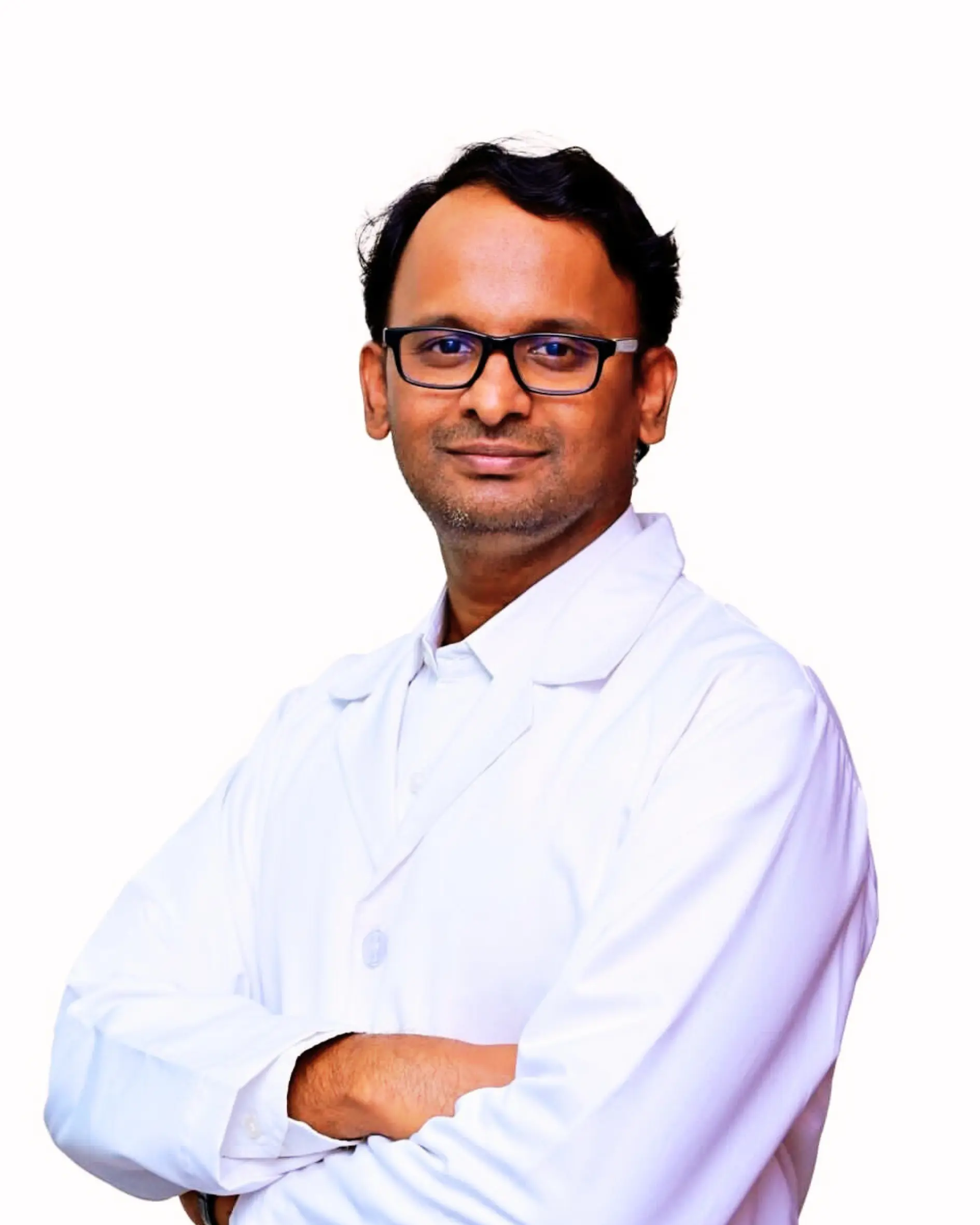
Dr. Srinivas Bojanapu is a Liver Transplant, HPB & GI Oncology Surgeon practising in Yelahanka and Electronic City, Bangalore. He completed his undergraduate training (MBBS) at M.S. Ramaiah Medical College, postgraduate training (MS General Surgery) at Mysore Medical College, and then pursued subspecialty training in Surgical Gastroenterology (DrNB) at Sir Ganga Ram Hospital, New Delhi — one of India's busiest HPB and transplant programmes.
He subsequently completed a Post-Doctoral Fellowship (PDF) in Liver Transplant and HPB Surgery under RGUHS, adding expertise in living donor hepatectomy and recipient transplant surgery to his HPB surgical repertoire. He is an active member of the International Hepato-Pancreato-Biliary Association (IHPBA), Liver Transplant Society of India (LTSI), and Indian Association of Surgical Gastroenterology (IASG).
DrNB from Sir Ganga Ram Hospital, Delhi — one of India's premier HPB training programmes. PDF in Liver Transplant & HPB under RGUHS. Not just general surgery with HPB cases.
Laparoscopic and robotic approaches offered first where oncologically safe. Smaller incisions, faster recovery, less blood loss — without compromising cancer clearance margins.
Dhaara Liver Clinic in Yelahanka (outpatient, consultation, minor procedures) and Kauvery Hospital, Electronic City (major HPB surgery with full ICU support).
Complex HPB cancers are discussed in multidisciplinary team meetings with medical oncologists, radiation oncologists, and radiologists before surgery is planned.
Conveniently located for patients in Yelahanka, Jakkur, Hebbal, Thanisandra, Sahakar Nagar, Devanahalli, and Airport Road corridor — avoiding long journeys to city-centre hospitals.
Told your tumour is inoperable? Referred from outside Bangalore? Dr. Srinivas offers dedicated second opinion consultations for HPB diagnoses.
You should ask for a referral to an HPB surgeon (or seek one directly) if any of the following apply:
A liver, pancreatic, or bile duct tumour has been found on imaging
You have been told a tumour is "inoperable" — get a specialist opinion
You have obstructive jaundice (yellow skin, dark urine, pale stools)
You have recurrent pancreatitis with a dilated pancreatic duct
You have a complex gallstone causing repeated bile duct blockages
You have been diagnosed with a cystic pancreatic lesion (IPMN, MCN)
Liver function tests are abnormal and imaging shows a liver mass
You are being evaluated for liver transplant (cirrhosis + portal hypertension)